
A deck rarely decides whether you buy a house, but it often decides what the first year in that house looks like. A home inspector walks the deck for the same reason a buyer should: the deck is a structure that carries people, holds snow for months, and connects to the house at exactly one vulnerable joint. Most of what matters about it can be seen in a short walk, if you know where to look.
This guide is written from the buyer side of the inspection. It is the companion to our code-focused piece on deck railing replacement and what inspectors check: that article explains what the code asks for when a guard is replaced, while this one explains what an inspector looks at before you sign, and what each finding means for your decision.
What an Inspector Actually Does on a Deck
A home inspector is not a code official, and the deck portion of a home inspection is not a code certification. The inspector walks the deck, looks at what is visible and reachable, tests the guard and stairs by hand, and reports condition: what is sound, what is worn, what is unsafe, and what needs a closer look by a specialist. The inspector does not open walls, lift decking, or dig up footings, and the report does not declare the deck compliant.
That distinction matters for a buyer. A flagged item is not automatically a failed deck, and a clean-looking deck is not automatically a sound one. The useful question after an inspection is narrower: which findings are routine wear, which ones point to a structural problem, and which ones need a follow-up before the purchase moves ahead. The five checks below are how to read the report with that question in mind.
The Five Checks That Matter Most
An inspector works through the deck in roughly this order, from the house outward. Each check has something you can see yourself on a second visit, and each one has a different consequence when it fails.
- The ledger connection. The ledger is the board that ties the deck to the house, and it carries much of the deck load. The inspector looks for flashing above the ledger, for rust or staining around the fasteners, and for any gap opening between the ledger and the house wall. Missing or failed flashing lets water sit against the house framing, and that is the failure that stays hidden the longest. A ledger problem is a structural problem, not a cosmetic one, and it is the first thing to ask a specialist about.
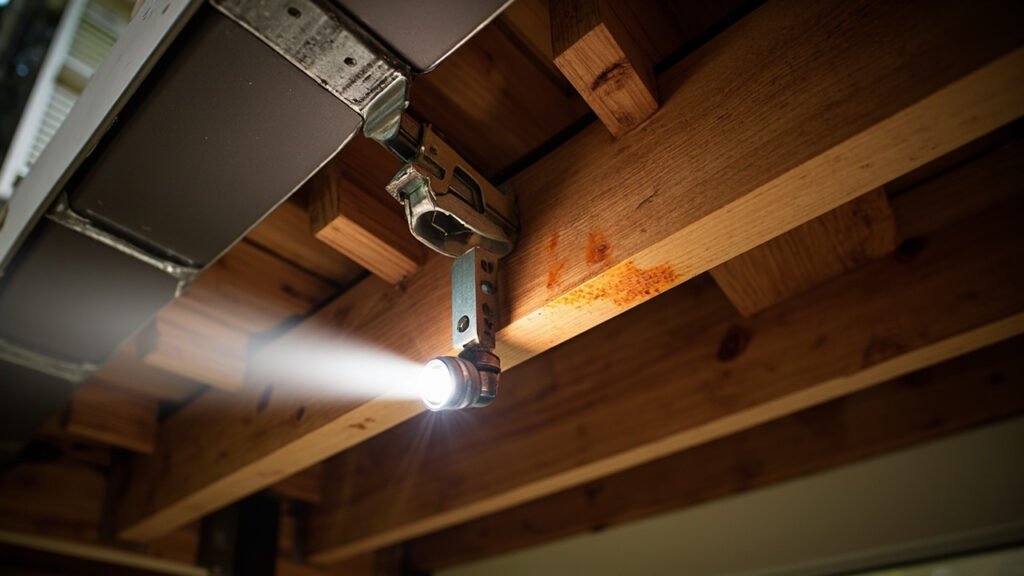
- Joists, beams, and rot. Under the deck, the inspector checks the joists and beams for sag, for soft or darkened wood, and for hardware that has rusted or pulled away. A screwdriver pressed gently into the end grain of a joist tells more than a glance from above: sound wood resists, rotted wood gives. The inspector also looks at how the joists connect to the ledger and to the beam, because a deck can look solid from the top while its connections underneath are failing.
- Posts and footings. The inspector checks whether posts sit plumb on their footings, whether the bases show rot where they meet soil or concrete, and whether the deck has settled or heaved unevenly. In Massachusetts, deck footings generally have to extend below the local frost depth (the building department sets the exact figure), and a footing that was set too shallow will lift and drop with the freeze-thaw cycle, leaving the deck out of level and the posts out of plumb. Uneven settlement is the sign to follow up, even when the decking above still looks flat.
- Guards and stairs. The guard gets the tape measure and the push test. The numbers behind a guard are exact: a guard is required where the deck surface sits more than 30 inches above the floor or grade below at any point within 36 inches of the open edge, the guard must be at least 36 inches tall, openings must not pass a 4-inch sphere, stair guards measure 34 inches from the tread nosing, and the guard must resist a 200-pound concentrated load at the top rail. An older guard that is short or widely spaced will be flagged as a safety item, and when the guard is replaced as a whole, the new guard has to meet the current standard in full. Our railing replacement piece walks through those four lines and what replacement involves.
- Drainage and hardware. The inspector looks at where water goes: whether the deck drains away from the house, whether leaves and debris are trapped against the ledger, and whether the fasteners, hangers, and brackets show the rust that follows years of meltwater. Our piece on deck permits in Massachusetts is the companion for the next step, because structural repairs of the kind this check uncovers are the kind of work that generally needs a permit. Hardware that has rusted through is not a maintenance note; it is a connection that no longer holds what it was sized to hold.
How to Read the Report When the Deck Is Flagged
Inspection reports use careful language, and buyers sometimes read a flagged deck as a reason to walk away, or a short flag list as a clean bill of health. Neither reading is quite right. A flag usually means one of three things: routine wear that any deck of that age shows, a defect that a specialist should verify before closing, or a safety item that needs fixing before the deck is used as it stands.
The way to sort them is to ask what the inspector could not see. A flag on the ledger or on the footings points to parts of the structure that are partly hidden, and those are the flags that deserve a follow-up visit by a licensed contractor or structural engineer who can look at the actual framing. A flag on the guard or on a stair tread is visible and measurable, and the railing replacement piece gives you the numbers to judge it against. What matters is not how many items are on the list, but whether any of them reach the structure underneath.
Checking the Permit History Before You Offer
The paper trail is the part of the inspection most buyers skip, and it is the part that answers a question the walk-through cannot: was this deck built, altered, or rebuilt with a permit, and was the work signed off when it was finished. In Massachusetts, the record lives with the town or city building department, where permit files are public records. The seller can also be asked directly for the permit and the final sign-off, and a listing that includes them is worth more than one that does not.

What to look for is straightforward: a permit that matches what is standing there now, including any rebuild or enlargement, and a final inspection that closed the permit out. A deck that was built or substantially altered without a permit, or a permit that was never closed, can surface at sale time, either in the inspection, in the title work, or when the next owner tries to pull a permit for further work. Our permit walkthrough covers when a permit is needed and what the process looks like, and it is worth reading before you treat the paper trail as a formality.
What to Do With What You Find
Take the inspection report back to the deck itself on a second visit, with the five checks above in hand. Walk the ledger line, look under the deck if access allows, push the guard, and walk the stairs the way the inspector did. Bring the permit question to the seller at the same time, while there is still room to get an answer before closing.
If the report flags the ledger, the framing, or the footings, ask a licensed contractor or structural engineer to look before you decide, and ask whether the fix needs a permit. If the only flags are the guard height or the baluster spacing, the railing replacement piece tells you what meeting the current standard involves. A deck that needs work is not necessarily a reason to pass on a house, but a deck that was never checked is not a deck you should assume is sound.
Local Reality Check
Here is the Greater Boston version of this story. Our decks carry snow for months, and the melt-and-refreeze cycle works on the ledger, the hardware, and the footings all winter, which is why the inspector checks in this guide are weighted toward water and movement rather than appearance. An older deck in Newton or Needham may have been built under earlier rules, and a guard that was acceptable when it was installed can still be flagged as a safety item when the house changes hands. The paper trail matters here for the same reason: a deck that was rebuilt without a permit leaves the next owner to sort out the record, and the towns around Boston keep those records where a buyer can ask for them. Walk the deck, read the report against the structure, and check the permit file before you offer, not after.
Frequently Asked Questions
Does a home inspector certify that a deck meets code?
No. An inspector reports the visible condition of the deck and flags what looks unsafe or worn. Code compliance is decided by the local building department, and a flagged item is a reason to follow up, not a code ruling.
What is the most serious thing an inspector can find on a deck?
Problems at the ledger connection and at the footings, because both carry the structure and both are partly hidden. A ledger with failed flashing or a footing that has heaved will be flagged for a specialist to verify before closing.
How tall does a deck guard have to be?
At least 36 inches from the deck surface to the top of the rail, with openings that do not pass a 4-inch sphere, and a guard is required where the deck sits more than 30 inches above the floor or grade below. Our railing replacement piece covers all four code lines in detail.
How do I check whether a deck was permitted?
Ask the seller for the permit and the final sign-off, and check the permit file with the town or city building department, where permit records are public. Look for a permit that matches what is standing there now and a final inspection that closed it out.
Should I walk away if the inspector flags the deck?
Not on the flag alone. Find out whether the flag reaches the structure underneath, get a specialist to verify ledger, framing, or footing problems before closing, and use the permit record to see whether past work was signed off. The decision turns on what the follow-up finds, not on how long the flag list is.