
What Ice Melt Does to Deck Hardware: Fasteners, Joist Hangers and Railings
When Boston homeowners think about winter deck care, they picture the boards: shoveling technique, which de-icer to buy, whether the surface will stain or pit. That is the visible half of the story, and it is the half every winter article covers. The other half is quieter and easier to miss: the metal that holds the deck together. The screws driven into every board, the hangers tying each joist to the ledger and the beam, the bases under the posts, the brackets anchoring the railings. Ice melt does not just sit on the boards. It dissolves into meltwater, and that meltwater finds every one of those metal connections. This article is about that half. What ice melt does to deck boards themselves is covered in our guide to clearing snow without damaging your deck; here we stay with the hardware.
The useful thing to understand first is that this is slow damage, not sudden damage. What happens is a quiet acceleration of a process that was already underway: corrosion. Chlorides make it run faster, and because the hardware is mostly hidden — under boards, inside hangers, behind brackets — the acceleration goes unnoticed until it shows up as staining, loosening, or red rust years earlier than it should have.
Why Ice Melt Is Tough on Metal
Corrosion needs three things: metal, oxygen, and an electrolyte — a liquid that carries the electrochemical reaction. Dry steel in dry air corrodes very slowly because the electrolyte is missing. Add water and the reaction can proceed; add water with dissolved chlorides and it proceeds much faster, because chloride ions make water a far better conductor. The active ingredients in most ice melts — sodium chloride, calcium chloride, magnesium chloride — are all chloride salts. Every time treated snow melts across a deck, the hardware gets bathed in a chloride solution.
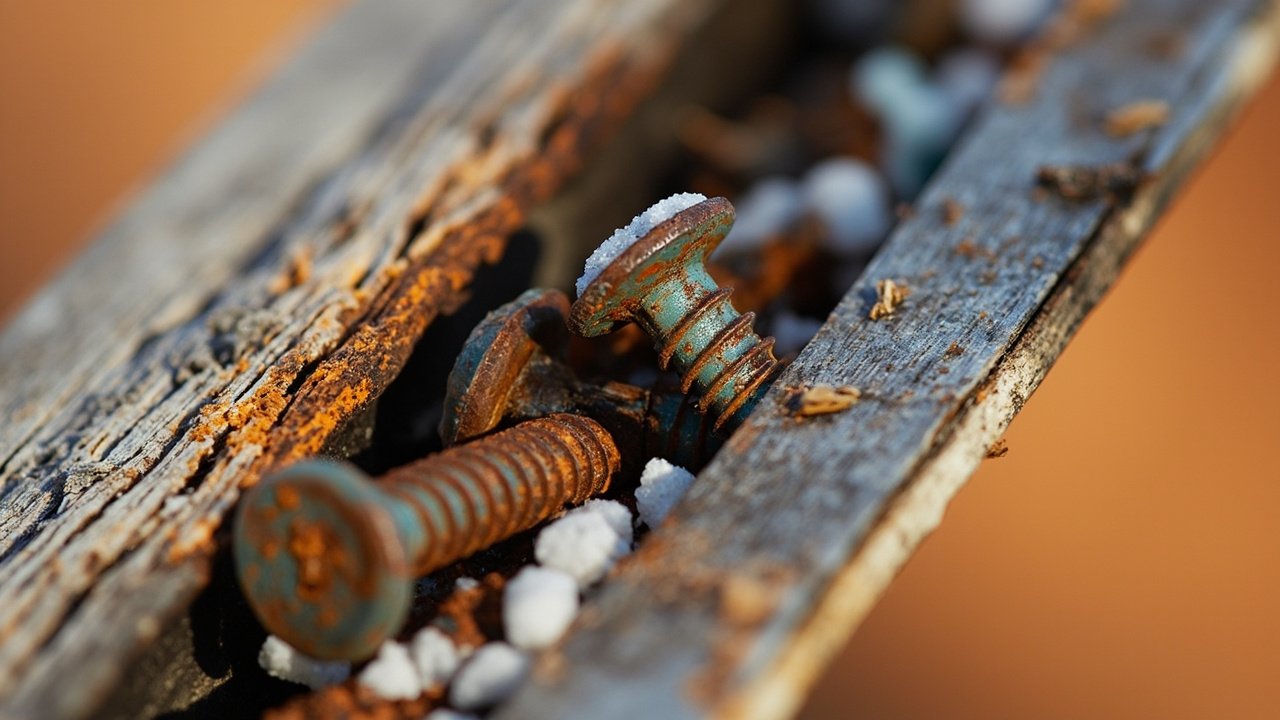
Most deck hardware fights this with a zinc coating. Galvanized hangers, nails, and screws rely on the zinc layer corroding preferentially, sacrificing itself to protect the steel underneath. Chlorides attack zinc as well as steel. Even heavy G-185 galvanizing has limits — the Journal of Light Construction notes corrosion becoming visible along the edges of a G-185-coated hanger after just weeks of exposure to salty air. Once the zinc is breached at one of those edges, the steel beneath is exposed and the corrosion that follows is the familiar red rust.
The manufacturers say this plainly, which is worth noting because manufacturers rarely volunteer bad news about their own products’ limits. Simpson Strong-Tie lists “exposed connectors in areas exposed to de-icing salts” among the applications for its stainless-steel connector line (Simpson Strong-Tie, Stainless-Steel Connectors), and describes Type 316 stainless as its maximum corrosion resistance for severe environments “where de-icing salts are present,” resistant to chlorides (Stainless Steel Solutions). Trade reporting in the Journal of Light Construction puts it in practical terms: stainless hardware is the better choice “alongside roadways on which salt chemicals are used to melt snow and ice in winter” and “for decks and landings on which the owners may apply ice-melt chemicals.” And the thinner coatings some dealers carry, G-90 or G-60, are intended for interior use only; the stamping on the hanger itself tells you which one you have.
The Four Places to Look
You do not need to disassemble anything to check your hardware. A walk-around in late winter or early spring, with your eyes and one hand, is enough to catch the early signs. What you are looking for: brown staining running down from a connection, red rust (distinct from surface staining), flaking or powdery coating, and fasteners that have loosened or backed out. Four spots deserve the attention:
- Board screws and fasteners. Face-driven screws leave a small recess around each head, and the Journal of Light Construction notes that these recesses let salty snowmelt puddle right around the fastener heads. Staining radiating from a screw head is the tell these recesses make easy to spot. On coated carbon-steel screws, red rust at the head means the coating is gone at that point; on stainless screws, blotchy staining can be surface discoloration rather than structural corrosion, which is a useful distinction before worrying.
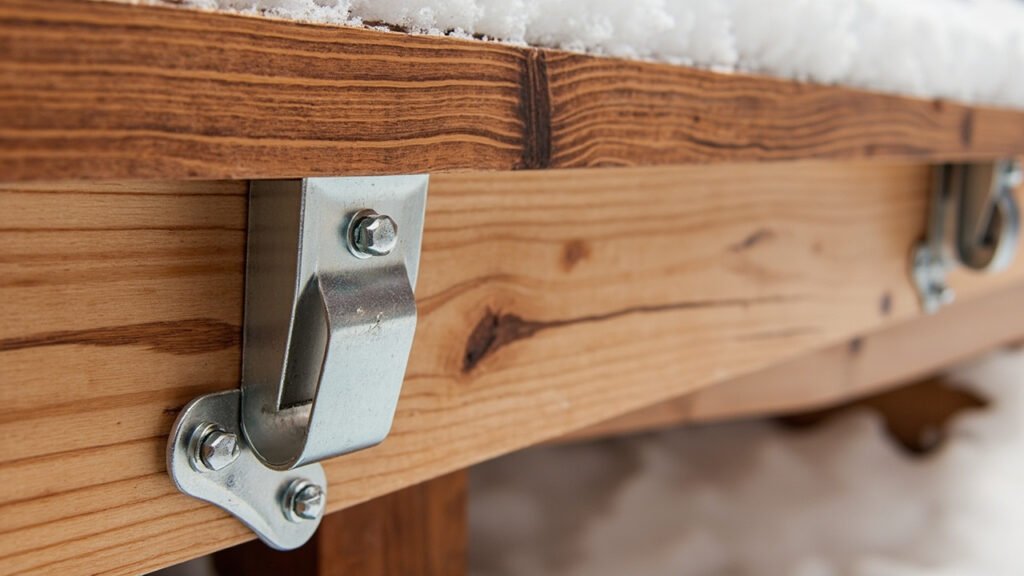
- Joist hangers. The workhorses of the frame — every joist ties to the ledger or the beam through one. Look at the edges and around the nail or screw holes — trade reporting notes even a heavy G-185 coating can show corrosion along the edges after weeks of salty-air exposure. While you are there, check the stamping on the hanger for its galvanizing level: G-185 (sold as ZMAX or Triple-Zinc) is the heavy exterior coating; thinner coatings were never meant for this exposure.
- Post bases and column bases. These live in the splash zone. Meltwater runs off the deck edge onto them, snow gets piled against the posts, and water bounces up from grade. A base that has sat in standing meltwater or been buried in a snowbank all winter has had the longest chloride bath on the deck. Look for rust at the bottom edge and where the base meets the concrete or the post.
- Railing posts and brackets. The most visible hardware on the deck, and usually the first place staining shows up. Railings deserve a stricter eye than the rest because they are a safety item, not a cosmetic one: a railing that feels loose at its bracket, combined with rust at the connection, is worth a professional look rather than a tighten-and-forget.
One rule governs all four spots, and both the manufacturers and the trade press stress it: match the fastener metal to the connector metal. Stainless fasteners with stainless connectors, galvanized with galvanized. Mixing them — stainless screws driven into a galvanized hanger, for example — sets up a galvanic pair in which the less-noble metal, the zinc coating, corrodes faster than it would alone. Simpson’s stainless connector guidance is explicit that carbon-steel or lower-grade fasteners become the weak link that can eventually compromise even stainless connectors. If any piece of hardware on an existing deck gets replaced, the replacement fastener should be the same metal as the connector it goes into.
Local Reality Check
Here is the Greater Boston version of this story. Many decks here sit close to plowed streets and driveways, which means road salt joins whatever the homeowner spreads — plow spray and splash reach the low framing and post bases whether you bought ice melt or not. In the coastal towns the air already carries salt; a winter of ice melt adds a second chloride source onto the same hardware. And our freeze-thaw rhythm keeps joints wet for weeks at a time instead of drying out between storms, which is exactly the sustained dampness corrosion prefers. The practical upshot is timing: late winter into early spring is the inspection moment, when the season’s full chloride load has landed and anything that started over winter is visible. A spring rinse of the hardware areas — post bases, the ledger line, railing brackets — washes the residue off before the warm, wet months arrive.
What You Can Actually Do
None of this requires rebuilding the deck. It requires looking, and then making the next hardware decision — at replacement time, or at build time — with chlorides in mind:
- Take the manufacturer’s guidance at face value where ice melt is an every-winter routine. Simpson Strong-Tie maintains a stainless-steel connector and fastener line specifically for applications including de-icing-salt exposure, with Type 316 as the top tier for chloride environments. That is the manufacturer telling you which shelf to look at.
- Keep the metals matched. Whatever the existing hardware is, replacements should be the same metal and coating — the galvanic penalty for mixing is well documented and entirely avoidable.
- Do not count on an isolation membrane to solve salt exposure. A membrane between hanger and treated lumber does break the galvanic reaction with the wood, which is a real benefit — but trade reporting is explicit that it does not solve exposure to salt from ice-melt products or coastal air. It is one layer of defense, not the answer.
- Rinse the residue in spring. Washing chloride-laden slush off post bases and out of hanger seats takes little effort and removes the electrolyte that would otherwise keep working through the wet spring.
- Consider a chloride-free ice melt for the walking surface. The Journal of Light Construction raises it as an option worth discussing, and for choosing a de-icer with the boards themselves in mind, our snow-clearing guide walks through the trade-offs agent by agent.
- Make hardware part of the seasonal routine. Simpson’s corrosion guidance recommends inspecting connectors and fasteners throughout the structure’s life, watching for loose connections and red rust. Add the four spots above to whatever spring checklist the deck already has.
- Ask the question at build or repair time. If a deck is being built or reframed, ask the builder what coating or grade the connectors and fasteners are. The stamping on the hanger answers it more reliably than a verbal assurance, and it is a reasonable question from any homeowner.
Frequently Asked Questions
I have used rock salt on my deck for years. Is the hardware ruined?
Not necessarily. What matters is the condition of the metal today, not the history of the salt bag. Surface staining is common and cosmetic; red rust, flaking coating, section loss, or loosening are the signs that something structural may be underway. If you see the second group, have a builder look before deciding anything.
If I rinse the deck every spring, am I covered?
Rinsing removes the residue that would keep feeding corrosion through the damp months, which is genuinely useful maintenance. It does not reverse corrosion that has already started under the coating. Think of it as slowing the process, not resetting it.
Should I replace all my fasteners with stainless?
For new hardware going into a spot that sees de-icing salts every winter, the manufacturer’s guidance points toward stainless, and toward matching the fastener to the connector. For an existing deck, wholesale replacement is a builder conversation, not a weekend project — the right scope depends on what the inspection finds.
The boards get the attention every winter; the hardware does the holding. A spring check of four spots — screws, hangers, post bases, railing brackets — is a small habit that catches slow damage while it is still surface staining. And if anything you find looks like more than that, that is a conversation with a builder, not a structural judgment to make from an article.